Are you of legal drinking age?
You must be over 18+ years to view this page.
Romanelli
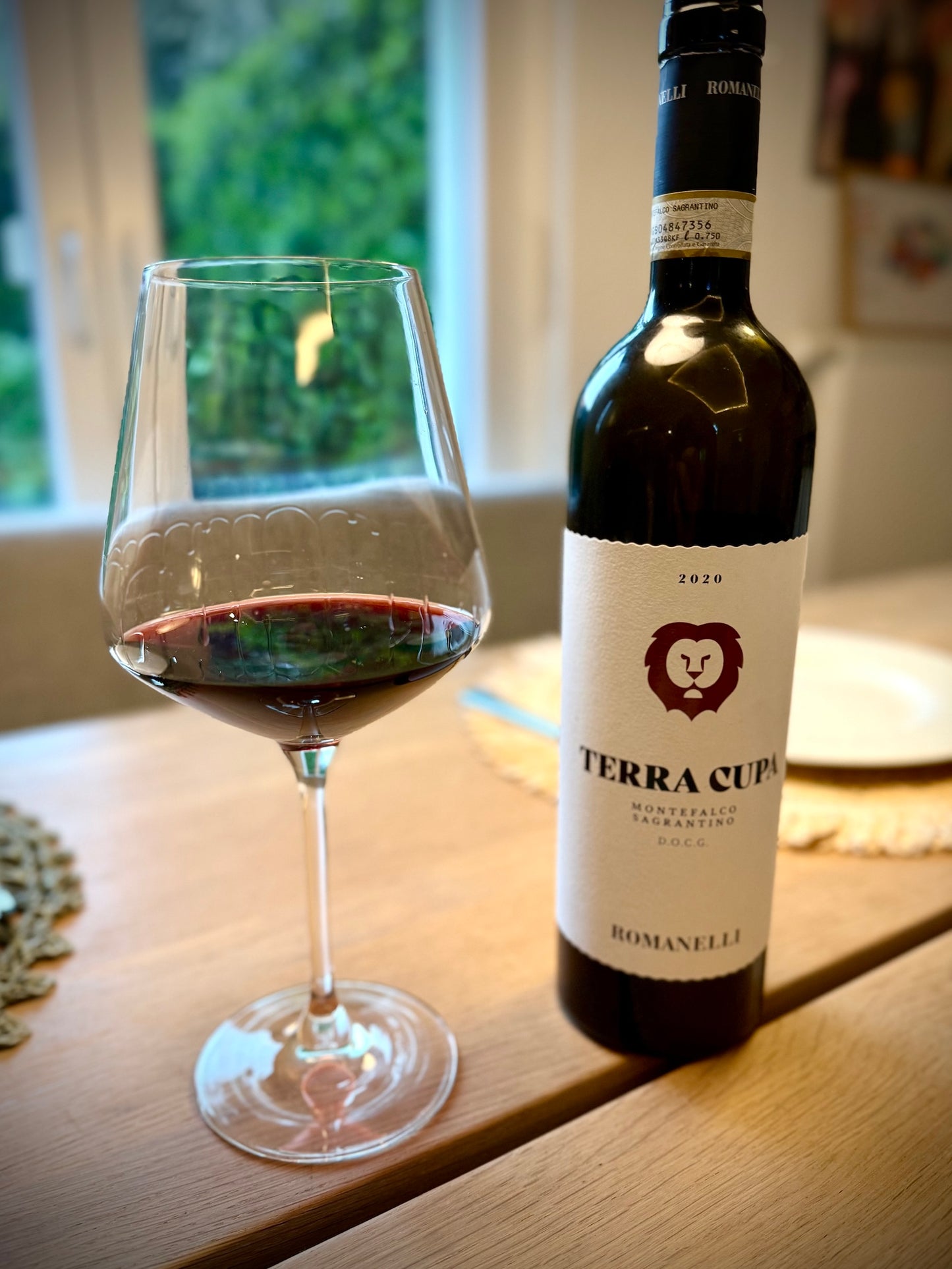
Terra Cupa
Terra Cupa
Red wine Β· Single varietal Β· dry
Origin: Italy, Umbria
Appelation: Montefalco Sagrantino DOCG
Grapes: Sagrantino
Alcohol: 16.0 % Β· Bottle size: 750 l
Terra Cupa is Romanelli's flagship expression of Montefalco Sagrantino, one of Italy's most celebrated indigenous red wines. Produced from late-harvested grapes grown on the hills of Colle San Clemente, it combines the formidable structure for which Sagrantino is famous with surprising freshness and elegance.
Long maceration, extended oak ageing and a further year in bottle create a wine of remarkable depth and longevity, capable of evolving beautifully over many years.
SKU: SKU:
In stock
Couldn't load pickup availability

Story behind the bottle Β· Terra Cupa
Among Romanelli's collection, Terra Cupa belongs to the historic "Wines of Tradition", the four wines that most closely represent the estate's connection to Montefalco and its cultural heritage.
The wine takes its name from a local road that runs alongside one of Romanelli's most important Sagrantino vineyards. The name highlights the unique characteristics of this site, where altitude, exposure and the presence of clay, limestone and small pebbles contribute significantly to the wine's aromatic profile.
The visual identity of Terra Cupa is equally meaningful. Romanelli's four Wines of Tradition are inspired by the celebrated fresco of the Four Evangelists painted by Benozzo Gozzoli in Montefalco. Each wine bears one of the traditional Evangelist symbols.
Terra Cupa carries the Lion of Saint Mark, a symbol of strength, character and enduring presence. It perfectly reflects the nature of this wine: powerful yet noble, structured yet capable of extraordinary evolution with time.
Notes in the glass
Terra Cupa presents in the glass with a deep, dark ruby color approaching garnet at the rim.
The nose is layered and complex, opening with blackberries, dried sour cherries and ripe plum, followed by balsamic herbs, cedarwood, cloves, sandalwood and subtle earthy nuances. With aeration, additional notes of dark chocolate, dried flowers and spice emerge, adding depth and sophistication.
On the palate, the wine initially reveals the classic tannic grip that defines great Sagrantino. Yet with time in the glass, the structure evolves dramatically. The tannins gradually transform from dominant to supportive, allowing layers of dark fruit, blackberry preserves, sour cherry and spice to emerge.
The combination of generous alcohol, vibrant acidity and powerful tannins creates a wine of remarkable balance and longevity. Persistent, contemplative and constantly evolving, Terra Cupa rewards patience and conversation.
Pairing: Excellent with game, braised meats, grilled lamb, aged cheeses, truffle dishes, wild boar ragΓΉ and rich Umbrian cuisine.
About the winery Β· Romanelli
The story of Romanelli is inseparable from the landscape of Montefalco and from a way of farming that predates modern specialization. Located on the hills of Colle San Clemente, overlooking the valleys that stretch toward Spoleto and Trevi, the estate has developed over three generations as a mixed agricultural system in which viticulture and olive growing coexist as complementary expressions of the same land.
Founded in 1978, the Romanelli family chose from the outset to root their work in a deep understanding of their territory rather than in short-term trends. Over the decades, this approach has translated into patient observation of individual parcels, soils, microclimates, and vine behaviour, leading to a gradual refinement of both vineyard management and winemaking choices. Today, the estate encompasses approximately 30 hectares of land, including vineyards and olive groves, cultivated with a constant focus on balance, biodiversity, and long-term sustainability.
Viticulture at Romanelli is shaped by continuity rather than disruption. The vineyards are integrated into a broader rural ecosystem marked by olive trees, woodland, and open hillsides, where agricultural practices have evolved slowly over time. This context informs the estateβs preference for restrained intervention, careful manual work, and the preservation of traditional methods whenever they continue to serve quality and site expression.
A defining element of Romanelliβs philosophy is the decision to vinify and bottle grapes from specific vineyard areas separately. Decades of study of the estateβs parcels revealed meaningful differences even within short distances, encouraging a parcel-based approach aimed at highlighting distinct identities rather than blending them away. From this vision emerged the estateβs cru wines, each linked to a particular site and agricultural history.
Within this framework, the recovery of Trebbiano Spoletino holds special significance. Long cultivated in Umbria but often overlooked, this variety found renewed attention at Romanelli through the restoration of an old vineyard which is still trained using vite maritata, an ancient system in which vines grow supported by living trees. This method, once widespread in central Italy, naturally limits yields, promotes loose bunches, and supports slow, even ripening β conditions particularly well suited to a late-ripening grape such as Trebbiano Spoletino.
The decision to preserve vite maritata alongside more contemporary training systems reflects Romanelliβs broader attitude: tradition is not treated as nostalgia, but as a practical resource when it proves agronomically and qualitatively sound. This coexistence of old and modern methods defines the estateβs identity and underpins its wines.
In the cellar, the same philosophy applies. Winemaking choices are guided by the character of the grapes and the intention to allow time to play an active role in shaping the wines. Extended skin contact, late harvests, and patient ageing are employed not to pursue stylistic effect, but to translate the structure, acidity, and natural balance of the fruit into wines capable of evolving over years rather than seasons.
Romanelliβs work with wine is inseparable from its work with olive oil, another expression of the same land and seasonal rhythm. After the grape harvest, attention shifts to the olive groves, where local varieties are harvested and pressed to produce oils that mirror the estateβs agricultural values: precision, restraint, and respect for raw material.
Ingredients, nutrition & allergens
Ingredients (allergens in bold): Natural ingredients : Grapes Β· Preservatives and antioxidants : Sulphites
| Nutritional values | Per 100 ml |
|---|---|
| Energy | 370 kJ / 88 kcal |
| Fat | 0.0 g |
| Β·Β·Β·of which saturates | 0.0 g |
| Carbohydrates | 2.0 g |
| Β·Β·Β· of which sugars | 2.0 g |
| Dietary fibers | 0.0 g |
| Protein | 0.0 g |
| Salt | 0.0 g |
Product information
| Legal Information | |
|---|---|
| Product designation | Red wine |
| Type/Color | Red wine |
| Alcohol content | 16.0 % vol |
| Country of origin | Italy |
| Region | Umbria |
| Appelation | Montefalco Sagrantino DOCG |
| Classification | Denomination of Controlled and Guaranteed Origin (DOCG) |
| Net quantity | 750 ml |
| Contains sulphites | Yes |
| Allergens | See tab above containing Ingredients, nutrition & allergens |
| Use & storage instructions | Store in a cool, dark place at a constant temperature of 13β18 Β°C |
| Producer & Importer | |
| Producer | Romanelli Devis; Via S.Clemente 129/A, 06036 Montefalco (PG), Italy |
| Contact | info@romanelli.wine |
| Responsible food business operator (Importer) | Tresmundi GmbH, Schwanenblumenplatz 18, 22119, Hamburg |
| Vineyard & Production Details | |
| Grape varieties | Sagrantino |
| Terroir | Clay, Limestone, Pebbles |
| Production method | The grapes are harvested manually at the end of October, one of the latest harvest periods in Umbria. This extended growing season allows the thick-skinned Sagrantino grapes to achieve complete phenolic maturity while maintaining freshness. After harvest, the wine remains in contact with the skins for approximately 60 days, an unusually long maceration that extracts color, aroma compounds and the powerful tannic structure characteristic of the variety. The wine is then transferred to oak barrels ranging from 225 to 2,500 liters, where it matures for around two years. The use of different barrel sizes allows slow development while preserving varietal expression. Following barrel ageing, Terra Cupa spends at least 12 additional months in bottle before release, allowing its components to integrate and soften. |
| Notices | |
| Label notice | Nutritional values and packaging may vary. For accurate information, please refer to the product description |
| Legal notice | Not for sale to persons under 18. Drink responsibly. |
From cellar to glas
π Selection
At Tresmundi, every wine is chosen with the utmost care β guided by the expertise of a certified wine professional with WSET Level 2. With deep knowledge of viticulture, winemaking, and tasting, we ensure that every bottle in our collection meets the highest standards of quality, balance, and character.
We focus on wines that tell a story β whether itβs a hidden gem from a small family estate or a timeless classic from a renowned region. What we offer is more than a drink: itβs an experience.
Food and wine are two of our greatest passions. They are among the richest and most rewarding pleasures in life β and we indulge in them as often as possible. When selecting our producers, we consider not only taste, appearance, or awards, but also their values, traditions, and sense of place. Above all, we value passion and respect for nature and craftsmanship. We make sure that each producerβs philosophy and vision are reflected in every drop.
Our focus lies on small, family-run wineries that work with dedication and heart. Every wine has a story worth telling. You wonβt find these bottles in supermarkets β nor in the vast catalogs of large online retailers. Our wines, and the stories they tell, are meant to be discovered and appreciated.
π‘ Storage
For us, every wine tasting is a sensual experience. Proper storage therefore plays a crucial role in preserving quality.
All wines in our selection at Tresmundi are kept in a specially designed wine cellar in Hamburg, maintained with controlled temperature, humidity, and sound insulation.
Bottles are stored horizontally and away from light sources, ensuring the cork remains in contact with the wine to prevent unwanted oxidation. This careful process allows each wine to develop beautifully and reach you in perfect condition.
π¦ Delivery
Our wines are shipped in certified DHL packaging designed specifically for safe wine transport (for wine orders only). If your order includes other products, we wrap each bottle securely in bubble wrap to minimize the risk of breakage.
- Choosing a selection results in a full page refresh.
- Opens in a new window.